
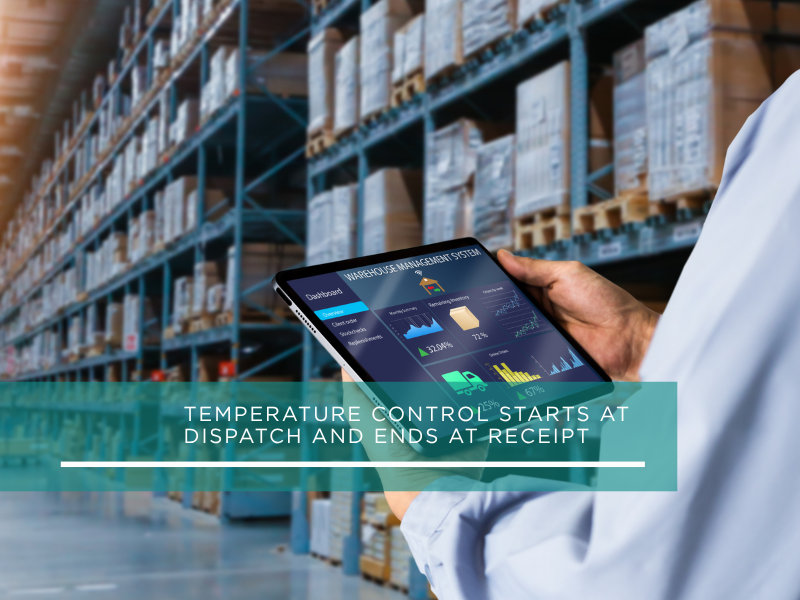
Temperature Control Starts at Dispatch and Ends at Receipt
Why every dispatch and receiving warehouse should have a reliable thermometer
The key principle: A refrigerated vehicle maintains product temperature — it is not designed to rapidly cool product that is already too warm when loaded.
In refrigerated transport, temperature control is a shared responsibility. LMC Express requires every client to measure and record the temperature of its products when we collect a consignment. We strongly recommend that both dispatch and receiving warehouses have access to a reliable, good-quality thermometer.
We have identified a sturdy and dependable thermometer that is well suited to the demanding conditions of food warehouses and would like to recommend it to our clients.
Why Temperature Measurement Matters
If products are dispatched outside the required temperature range, the vehicle’s refrigeration unit may not be able to correct this during the journey. This can affect product quality, shelf life and food safety. It can also create uncertainty about where and when a temperature deviation occurred.
- The dispatch temperature confirms the condition of the product when it was handed to LMC Express.
- The receiving temperature confirms its condition upon arrival.
- Comparing the readings helps identify whether a change occurred during storage, loading, transport, offloading or receiving.
- Accurate records support a fair and efficient investigation if a temperature-related query or claim arises.
LMC Express Checks at Collection and Delivery
Our local collection and delivery vehicles are equipped with infrared laser temperature guns. These devices allow our drivers to perform quick, non-contact surface-temperature checks.
We use infrared thermometers instead of needle thermometers because a probe inserted into different products can introduce a contamination or cross-contamination risk if it is not correctly cleaned and sanitised between every use.
However, an infrared thermometer measures the surface temperature of the product or packaging — not necessarily the internal or core temperature of the product.
Important: The driver’s infrared reading is a practical guideline only. It is intended to alert the client when a surface-temperature reading appears to be off specification, so the client can investigate before loading.
The driver’s infrared reading does not replace the client’s own temperature-control procedures, calibrated equipment or dispatch records. The dispatch warehouse remains responsible for confirming and recording the product temperature using the appropriate method and suitable equipment, as per LMC Express’s T&C.
Why Every Dispatch Warehouse Needs a Thermometer
Before handing refrigerated or frozen products to LMC Express, the dispatch warehouse should confirm that the products are within the correct temperature range. This helps identify a problem before the product leaves the premises and avoids later uncertainty about its condition at loading.
- Verify that products are ready for loading.
- Detect cooling or freezing problems before collection.
- Confirm the product temperature if the driver’s infrared reading raises a concern.
- Record the temperature against the LMC Express waybill.
- Provide evidence of the product’s condition at the point of handover.
- Avoid loading products that already fall outside the required specification.
Why Every Receiving Warehouse Needs a Thermometer
The receiving warehouse is the final control point. Products should be checked promptly upon arrival and before they are moved into storage or rejected.
- Verify the product temperature immediately upon delivery.
- Compare the reading with the recorded dispatch temperature.
- Identify and report any concern while the driver is still present.
- Record objective information instead of relying on touch or appearance.
- Reduce disagreements and delays when investigating a temperature query.
A product cannot reliably be declared too warm or too cold based only on how its packaging feels or on an infrared surface reading. The appropriate product-temperature measurement and supporting records are required.
Reliable Equipment Produces Reliable Information
Not all thermometers are equally suitable for a busy food warehouse. A device used in refrigerated logistics should be:
- Accurate and consistent.
- Strong enough for regular warehouse use.
- Easy for employees to operate.
- Suitable for chilled and frozen products.
- Easy to clean and sanitise.
- Capable of providing a clear reading quickly.
The thermometer should be checked and calibrated according to the manufacturer’s recommendations. A damaged, inaccurate or poorly maintained device can create misleading records.
Good Measurement Practices Are Equally Important
Possessing a thermometer is only the first step. Warehouse employees should be trained to use it correctly and should follow a consistent procedure:
- Take the temperature as close as possible to the time of loading or receiving.
- Select a representative sample from the consignment.
- Use the correct measuring method for the product and packaging.
- Clean and sanitise the probe before and after use, where applicable.
- Record the temperature, date, time, product and employee’s name.
- Report any reading outside the required range immediately.
- Retain the record with the relevant dispatch or receiving documentation.
The required product temperature should be confirmed by the manufacturer or supplier, as different products may have different specifications.
Protecting the Entire Cold Chain
Temperature control is not the responsibility of the transporter alone. It depends on every party in the cold chain doing its part — from production and cold storage to dispatch, transport and final receipt.
A reliable thermometer is a relatively small investment, but it can help protect valuable stock, support food-safety standards and prevent costly disputes.
For this reason, LMC Express requires temperatures to be taken when products are collected and strongly recommends that every client ensure that both its dispatch and receiving warehouses possess a suitable, reliable thermometer.
IF YOU CANNOT MEASURE IT, YOU CANNOT VERIFY IT.






Leave a Reply